Some crimes disappear from the headlines after a few days. Others stick with people. The Idaho college murders is one of those cases that people still talk about on Reddit threads at 2 AM, in true crime podcasts, and in long YouTube breakdowns. It’s the kind of case that makes you double-check your locks before going to sleep.
Back on November 13, 2022, the quiet college town of Moscow, Idaho – the kind of place where violent crime almost never happens – suddenly became the center of one of the most disturbing murder investigations in recent American history.
Four University of Idaho students were found stabbed to death inside an off-campus rental house. No forced entry. No immediate suspect. No clear motive.
And for weeks… nothing made sense.
The victims were:
Kaylee Goncalves
Madison Mogen
Xana Kernodle
Ethan Chapin
All young. All with futures ahead of them. All killed sometime in the early morning hours while most of the town slept.
At first, police gave very little information. And that silence actually made things worse. Rumors started flying everywhere — TikTok theories, Reddit detectives, people accusing random strangers. It became one of those internet storms where everyone thought they had the answer.
But investigators were doing something much quieter.
They were building a case piece by piece.
And what they eventually uncovered would lead to a name nobody expected: Bryan Kohberger.
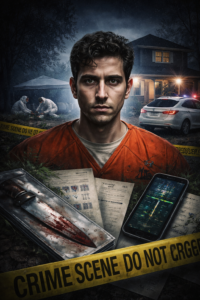
What made this case hit different wasn’t just the brutality – it was how normal everything looked before it happened.
The house on King Road wasn’t some shady location. It was basically a typical college party house. Friends coming and going. Late night DoorDash runs. Music. Laughing. The usual stuff.
On the night before the murders, nothing seemed out of place.
Kaylee and Madison had been at a food truck downtown. There’s even video of them joking around while waiting for their order. Xana and Ethan had been at a party. Totally normal Saturday night.
Around 4 AM, everything changed.
Investigators later determined the killer likely entered through a sliding glass door. No signs of forced entry. Which suggested either the door was unlocked – pretty common in college towns – or the killer knew how to get inside.
One of the most chilling parts?
Two roommates were inside the house and survived.
One later told investigators she saw a masked man walking past her toward the exit. She described him as having “bushy eyebrows.” That detail sounds small, but it would later become incredibly important.
At the time though, she thought maybe it was just someone leaving after a party.
Imagine realizing later what you actually saw.
For weeks police had almost nothing public to share. But behind the scenes they were tracking something critical:
A white Hyundai Elantra.
Cameras had picked it up near the house multiple times. Driving past. Turning around. Circling. Like someone scoping the place out.
Then investigators went deeper.
Cell phone data showed a phone that had been near the house multiple times in the months before the murders. Then suddenly – during the actual time of the killings – the phone went dark.
Then turned back on again afterward.
That raised a huge red flag.
Because to investigators, that looks like someone trying to avoid being tracked.
And that’s when Bryan Kohberger entered the picture.
Kohberger wasn’t some random drifter. That’s what made this even creepier.
He was a criminology PhD student studying criminal behavior. Someone literally studying how criminals think.
Let that sink in for a second.
A guy studying crime… allegedly committing one of the most talked about murders in years.
He had recently moved to Washington State University, just about 10 miles from Moscow. Close enough to drive in minutes.
Police started quietly watching him.
Then came the forensic break that changed everything.
DNA.
A knife sheath was found at the crime scene. On it, investigators located DNA that eventually matched Kohberger through genetic genealogy techniques. Basically the same kind of technology used in cold cases like the Golden State Killer.
From there, investigators tracked him across the country.
Because after the murders, Kohberger drove back to Pennsylvania with his father. A cross-country road trip that in hindsight feels incredibly eerie.
Police followed him for days.
Watching.
Waiting.
Building the case.
Then on December 30, 2022, tactical teams arrested him at his parents’ home.
Just like that, the biggest mystery in America had a suspect.
But even after the arrest, questions kept piling up.
Why those victims?
Why that house?
Was he stalking them?
Investigators believe Kohberger may have visited the area at least a dozen times before the murders. Some believe he may have been watching the house for weeks or even months.
Still no clear motive has ever been fully explained publicly.
Which honestly makes the whole thing even more disturbing.
Because people want reasons. People want logic.
And sometimes there just isn’t any.
Another thing that made this case explode online was how much digital evidence existed.
Surveillance cameras
Phone pings
Traffic cameras
DNA
Timeline reconstruction
This wasn’t a mystery from the 1980s. This was modern forensic work in real time.
It showed how today, even someone who thinks they planned everything can still leave a trail.
And according to investigators, Kohberger left plenty.
Even things like purchasing gloves and cleaning his car became part of the narrative prosecutors built. Small behaviors that, when stacked together, start painting a picture.
No single thing proves everything.
But together?
That’s how cases are built.
The legal process is still unfolding, and this case could take years to fully resolve. Motions, hearings, evidence battles — the usual courtroom chess match.
But one thing already seems certain:
This case changed how people think about safety in college towns.
Students started locking doors again. Parents started worrying more. Universities reviewed security policies.
Because crimes like this shatter the illusion that “it can’t happen here.”
It can.
And sometimes it does.
Even now, people still ask the same questions:
Was he acting alone?
Was this planned for months?
Why this house?
Why that night?
Some of those answers may come out at trial.
Some might never be fully explained.
And that’s what keeps people talking about the Idaho student murders even today.
Because some cases don’t just end.
They stay with people.
Leave a Reply